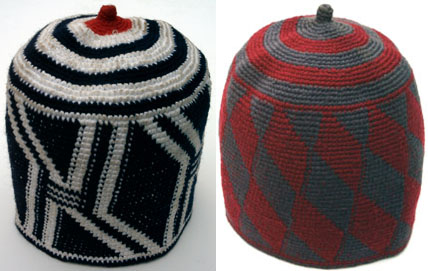
Archive for the ‘Tapestry Crochet, Africa’ Category

Back to Ghana

Tuesday, September 22nd, 2009

Like last year, my trip to Ghana was very interesting, but exhausting. A day after arriving home from the CGOA Conference in Buffalo, I was on a plane to Accra, then school started the day after I returned home from Ghana - so I’m still working on my recovery!

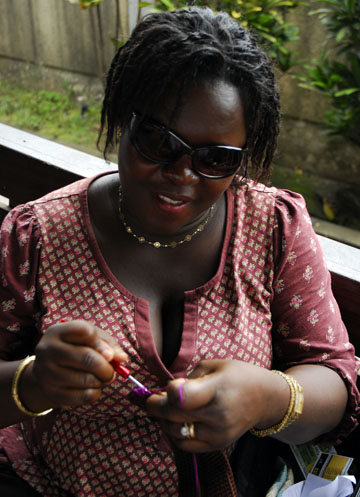
Carol tapestry crocheting in Ghana
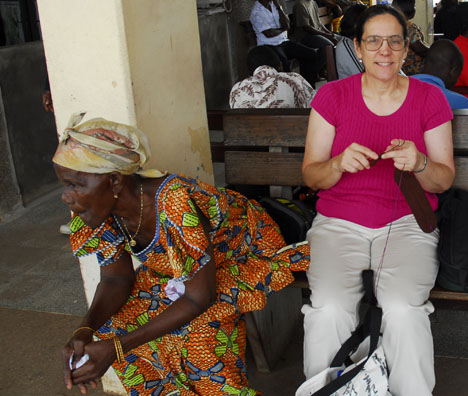
I started to tapestry crochet a bag with size 18 Omega nylon in the airport, then worked on it while waiting for the bus to Kumasi. This is how I looked after being awake for 24 hours - and I still had a 7 hour bus ride to go!

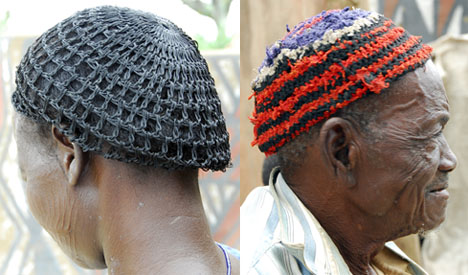
I was on the lookout for crochet everywhere! I didn’t see many examples, but did see some women wearing black net-like double crocheted hats and a few men with colorful single and tapestry crocheted hats.

Crochet Hats in Sirigu, Ghana
Double and single crocheted hats in Sirigu.

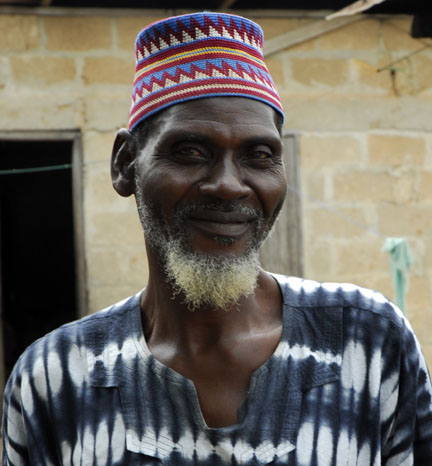
Many Muslim men in Ghana wear tapestry crocheted hats. I spotted the gentleman below in Krofofrom while researching lost wax casting.

Tapestry crochet hat worn in Ghana
This Muslim man from Krofofrom told me that his hat was crocheted in Bogo, Ghana.

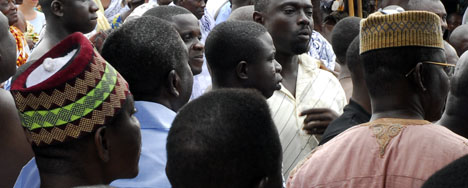
Tapestry crocheted hats in Ghana
Fabulous imported tapestry crocheted hats worn in Kumasi.

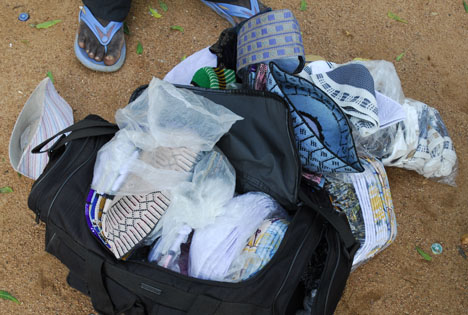
A traveling salesman in Bolgatanga was selling both embroidered and tapestry crocheted hats. Guess which ones I bought?

Hats for sale in Bolgatanga, Ghana
Embroidered and crocheted men’s hats for sale in Bolgatanga.

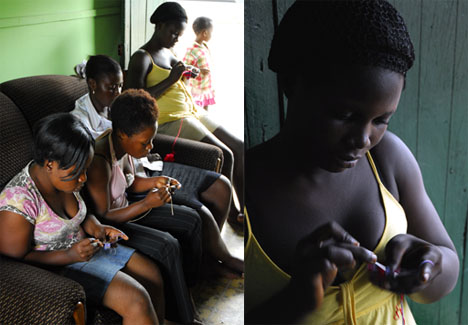
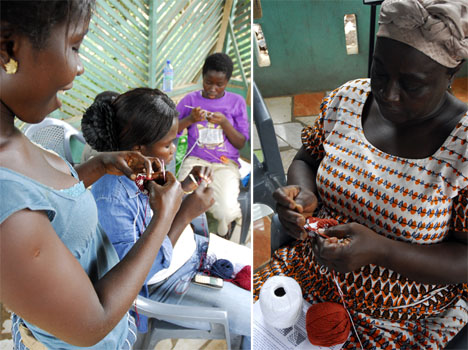
While researching adinkra in Ntonso, I taught four members of the THREAD group how to tapestry crochet a cell phone bag. They learned how to double crochet in school with thread and small steel crochet hooks, but didn’t know the single crochet stitch, so it was a challenge for them to do the new stitch, carry the other thread, and change colors with a larger hook - but they eventually got it!

Learning to tapestry crochet in Ntonso, Ghana
Women learning how to tapestry crochet a cell phone bag in Ntonso.

I was so busy the 3 weeks I worked and traveled in Ghana that I didn’t make much progress on my own bag. While waiting for the bus to bring me back to Accra, Arden approached me to ask what I was doing. I was so thrilled that she was interested that I gave her a mini lesson! She also learned just the double crochet stitch in school. After showing her how to single crochet and change colors, I handed her my bag and she gave it a try.

Arden tapestry crocheting in Ghana
Arden gives tapestry crochet a try.

So I planted a few more tapestry crochet seeds in Ghana. Hopefully, they will take root and the next time I go to Ghana I will not have such a difficult time finding tapestry crochet!

Ghana

Monday, August 25th, 2008

Sorry I’ve been MIA. I planned to blog in Ghana, but the internet connections were just too slow. Thanks to the internet, though, I was able to arrange two informal tapestry crochet classes before I left home. So along with my clothes and cameras, went thread, hooks, books, and project instructions.

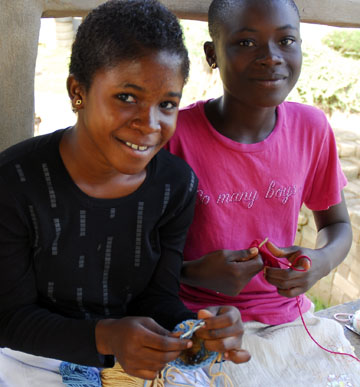
Gladys and Regina tapestry crocheting.
Gladys and Regina were the first to try tapestry crochet (in Nungua). Although they had just recently learned to crochet, both young ladies were very excited to try something new.

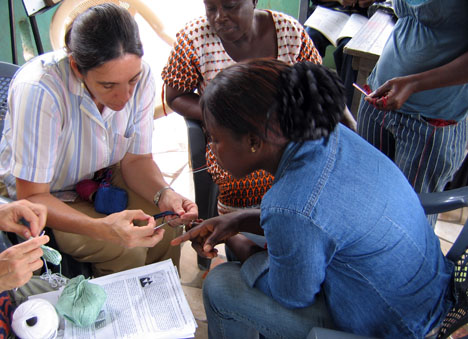
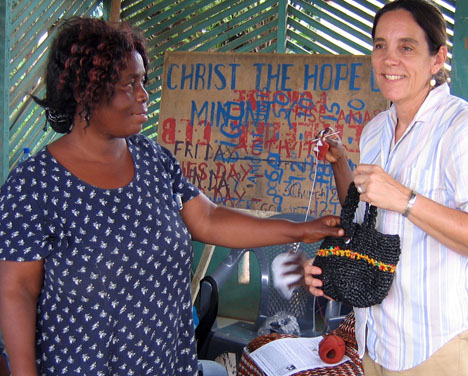
The second group I taught is sponsored by Womens Trust in Pokuase. Jackie Abrams is helping them establish a cottage industry by teaching the Kami Ami how to crochet purses and baskets with strips cut from garbage bags.

Kami Ami Group in Pokuasi, Ghana
The Kami Ami were very interesting in learning how to do tapestry crochet.

Kami Ami Tapestry Crocheting
And they caught on fast!

“Kami ami” means “do it loose.” When Jackie first taught the ladies how to crochet, they were doing it too tightly, so they kept saying to each other, “kami ami.” Later, they adopted the name for their group!

Crochet Purse Gift from Tina Ankrah in Pokuase
Tina Ankrah presented me with one of the wonderful purses that she crocheted with plastic strips.

Jackie emailed me that the women (and a young boy who also caught on very quickly) were still tapestry crocheting and that they were incorporating it into the pieces crocheted with plastic strips, too! She promised to send pictures when she returns home, which I’ll share in another blog.

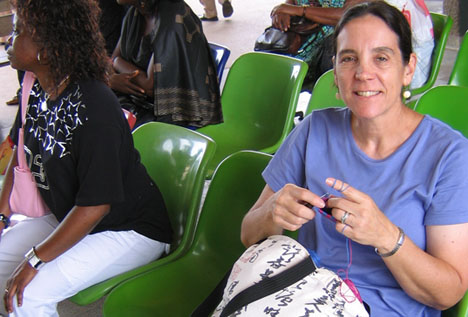
Waiting for a bus
Tapestry crocheting a cell phone bag while waiting for a bus.

All in all, I didn’t see much crochet in Ghana – just a few hats and bags here and there - but I did my best to spread the word by tapestry crocheting whenever and wherever I could. I’m hoping that more people will discover it and that the ones who learned this fabulous craft will teach lots and lots of their friends and families!

Tapestry Crochet in Morocco

Friday, September 21st, 2007

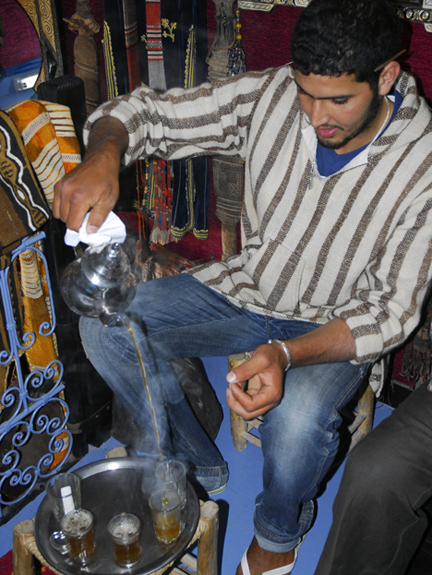
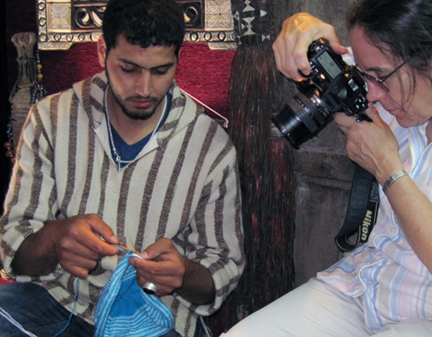
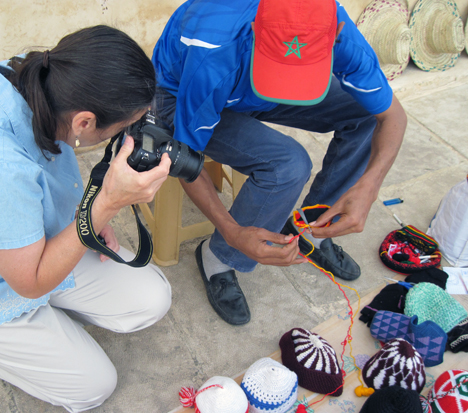
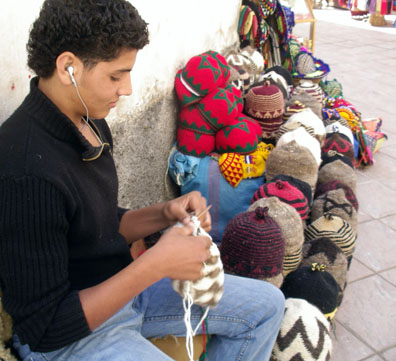
The Internet and tapestry crochet did it again! This time they introduced me to Bronwyn Menton from Australia! What a happy surprise to receive an email from her with the picture of the young man (below) tapestry crocheting in Essaouira, Morocco.

Crocheter in Morocco
This hip fellow listens to music while he sells and tapestry crochets hats like the one below.

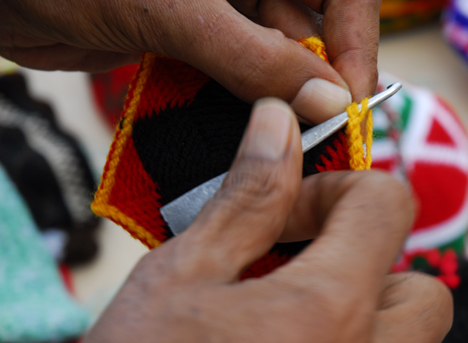
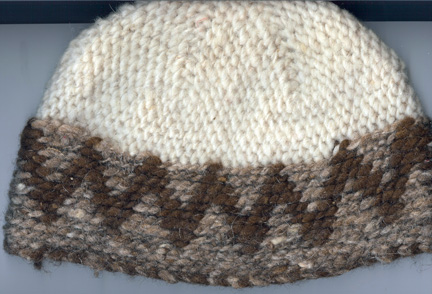
Slip stitched hat from Morocco
He tapestry crochets with slip stitches.  It is impossible to carry the other yarn with the slip stitch, so . . .

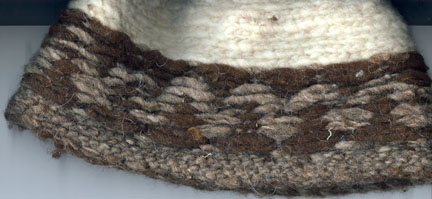
Inside view of Morocco hat
. . . the other yarn runs along the back of the stitches.

Bronwyn explained, “The hats that the young lad was making I think were for the beanie wearing fashion conscious adolescents, fishermen and tourists – or maybe just for people to keep their heads warm rather than for cultural reasons.  Essaouira has a very hip culture musically (Jimmi Hendrix, Cat Stevens and Leonard Cohen all spent a lot of time there) and is a centre for African music festivals.  It also has a surfing culture – even saw a surf shop with its own brand of clothing to rival our Aussie brands.  But the main thing that happens in Essaouira is fishing and I reckon it would be mighty cold out on the Atlantic in those little blue boats!  Hence my opinion about who buys the woollen hats. The wool used in this beanie, and many others is often what the Moroccans call ‘dead wool’.  This means that it is wool that has been taken from sheep already slaughtered for meat.  The wool is of a poorer quality than ‘live wool’ and usually has a very unpleasant smell.  I had to wash the beanies several times to get rid of the smell!”

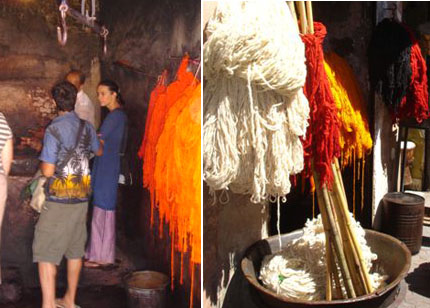
Wool in Morocco
Bronwyn saw both natural and synthetic dyes being used to color wool (used primarily for carpet weaving) in large ceramic vats at Djemaa el-Fna, the huge market in the heart of Marrakesh.

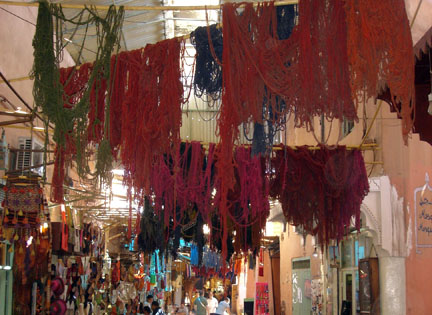
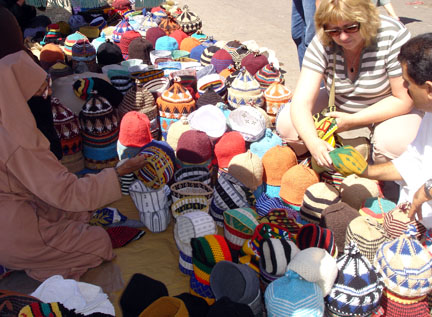
Market in Morocco
The market she visited sells both raw materials and the finished products.

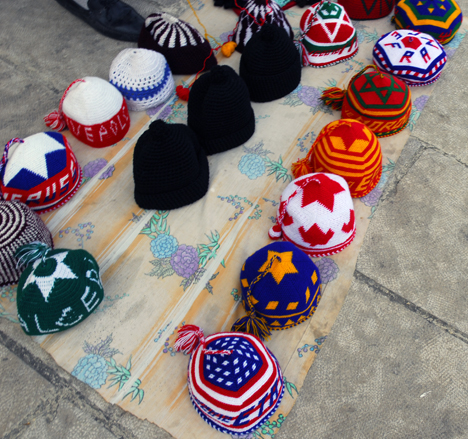
All of the hats that Bronwyn saw for sale in Marrakesh were tapestry crocheted with acrylic yarn and often included gold or silver thread.

Bronwyn buying hats in Morocco
So many choices! Bronwyn met the challenge with flying colors in Marrakesh.

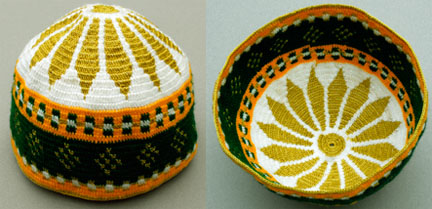
Tapestry crochet hat from Morocco
This is the icing on the cake! Bronwyn gave me this Moroccan hat!

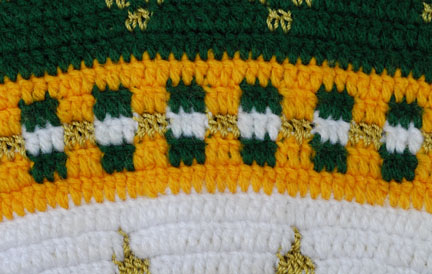
Detail of a hat from Morocco
This hat was double crocheted with fine acrylic yarn and metallic thread.

Bronwyn’s last email said, “. . . I so want to go back there!  It was a really fascinating place – so colourful, varied and culturally rich.  I was looking at the mosaics in the Blue Mosque in Casablanca and they reminded me of the photos you posted from Spain.  There is just so much to see and so little time . . .”

Until I heard from her, I did not realize that tapestry crochet was done there. This fantastic news moves Morocco towards the top of my list of places I HAVE TO VISIT SOON. Thanks so much, Bronwyn!

Tapestry Crochet in Cameroon

Saturday, September 8th, 2007

Men’s tapestry crocheted and looped hats are very popular in the western highlands of Cameroon in Central West Africa. Sometimes the styles are meaningful (denoting status, a specific event, or one’s home town), other times the hats are just fashion statements.

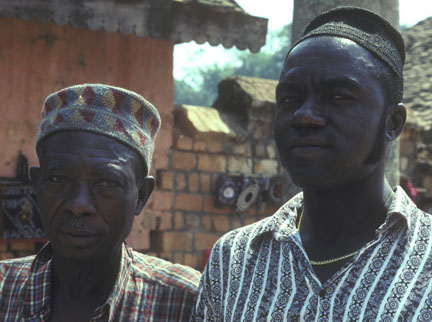
Men in Bafut, Cameroon
Both tapestry crocheted (left) and looped hats (right) can be seen in Bafut. Tapestry crocheted hats of a different style are for sale on the wall behind them. (2000)

Detail of looped hat from Cameroon
Detail of a looped hat from Cameroon.

How are looping and crochet related? They are similar, but with looping the entire strand is pulled through each loop; only a small loop is pulled through another loop with crochet. Looping is an ancient technique, but no one knows when or where tapestry crochet developed. I suspect loopers embraced it because tapestry crochet is quicker.

Tapestry crochet is one of many crafts done in Foumban, home of the Bamum (Bamun, Bamoun) people. The early 20th century Sultan Njoya encouraged metal casters, leatherworkers, potters, embroiderers, woodcarvers, beadworkers, and other craftspeople to move there and a hundred years later, it is still the center of craft production in Cameroon.

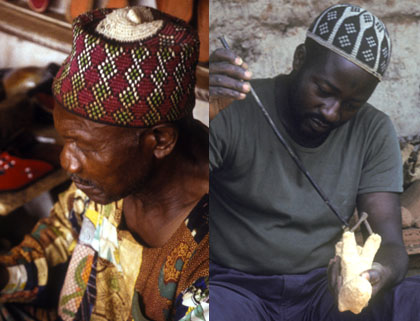
Foumban Craftsmen
A Bamum leather worker and a sculptor wear tapestry crocheted hats with diamond motifs, but each is quite distinctive. (2000)

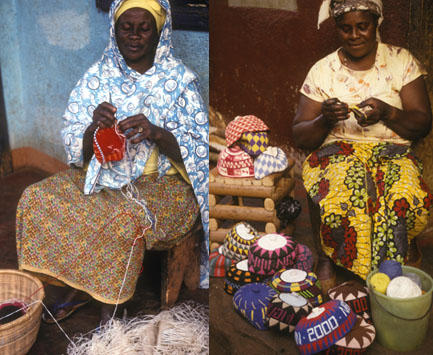
Crocheters from Foumban, Cameroon
Bamum crocheters often carry recycled synthetic sack fibers to stiffen the hats they tapestry crochet with cotton and acrylic yarns. The hats on the right commemorate the local semiannual Nguon festival. (2000)

Detail of a Hat from Foumban, Cameroon
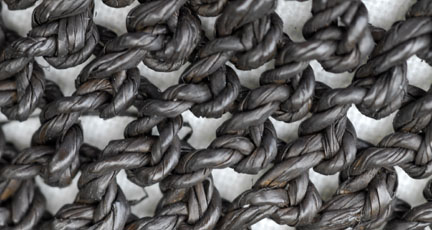
Detail of the synthetic carried fiber carried in Foumban. Notice that the top loop of each stitch is laying over the next one. This happens when the yarn color is changed after completing the stitch (instead of when 2 loops are still on the hook).

Hats from Foumban, CameroonHats from Foumban, Cameroon
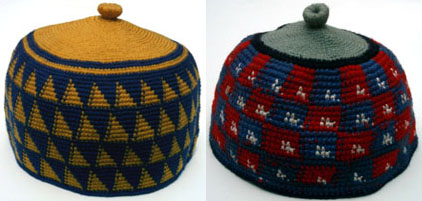
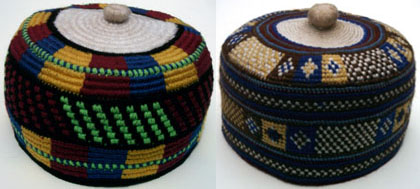
These tapestry crocheted hats are from Foumban. The knob on the top is a decorative element that is specific to that town. (2000)

Although I observed more women tapestry crocheting than men when I visited in 2001, I did find one male crocheter in Dschang.

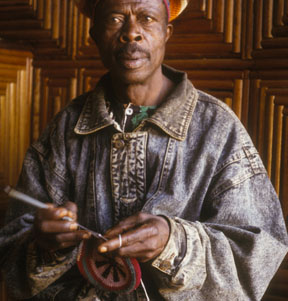
Man crocheting in Dschang
This Bamileke man from Dschang is crocheting a hat like the one that he made below. (2000)

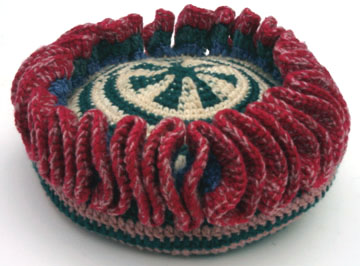
Hat from Dschang, Cameroon
Aren’t the crocheted ruffles fabulous? (2000)

Hats from Dschang, Cameroon
These tapestry crocheted hats are also from Dschang and are more typical of the hats worn there. (2000)

I suggested in an earlier blog that Korsnäs tapestry crochet might have evolved from nalbinding, an ancient looping technique. I believe the same thing happened in Cameroon. My next blog will show a similar development in Guatemala.


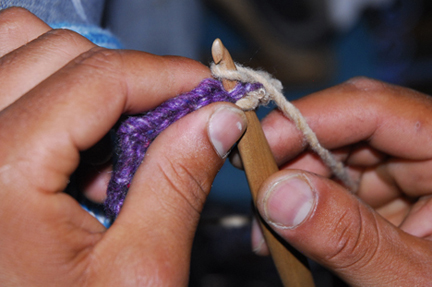
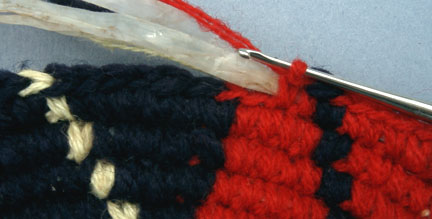
This is how colors are changed
in tapestry crochet.


by Carol Ventura

FOR MORE INFORMATION ABOUT
THE TAPESTRY CROCHET BOOKS
BELOW, PLEASE CLICK ON THEM:


THE FOLLOWING PUBLICATIONS
INCLUDE ONE OR MORE OF MY
TAPESTRY CROCHET PROJECTS.
CLICK ON THEM FOR MORE INFO:


FOR MORE INFO ABOUT THE
TAPESTRY CROCHET PATTERNS
BELOW, PLEASE CLICK ON THEM:


Crochet Blogs

Powered By Ringsurf


Check out..
Check out the Top 50 Crochet sites!
..these Crochet sites!


The Crochet Liberation Front Blog Ring
Powered By Ringsurf

Tapestry Crochet Blog Ring
Powered By Ringsurf


Crochet Blogs - BlogCatalog Blog Directory


FaveCrafts.com Crafts, Home Decor, Scrapbooking, Quilting, and More


Add to Technorati Favorites


Enter your Email


Preview | Powered by FeedBlitz


Counter
Free Counter