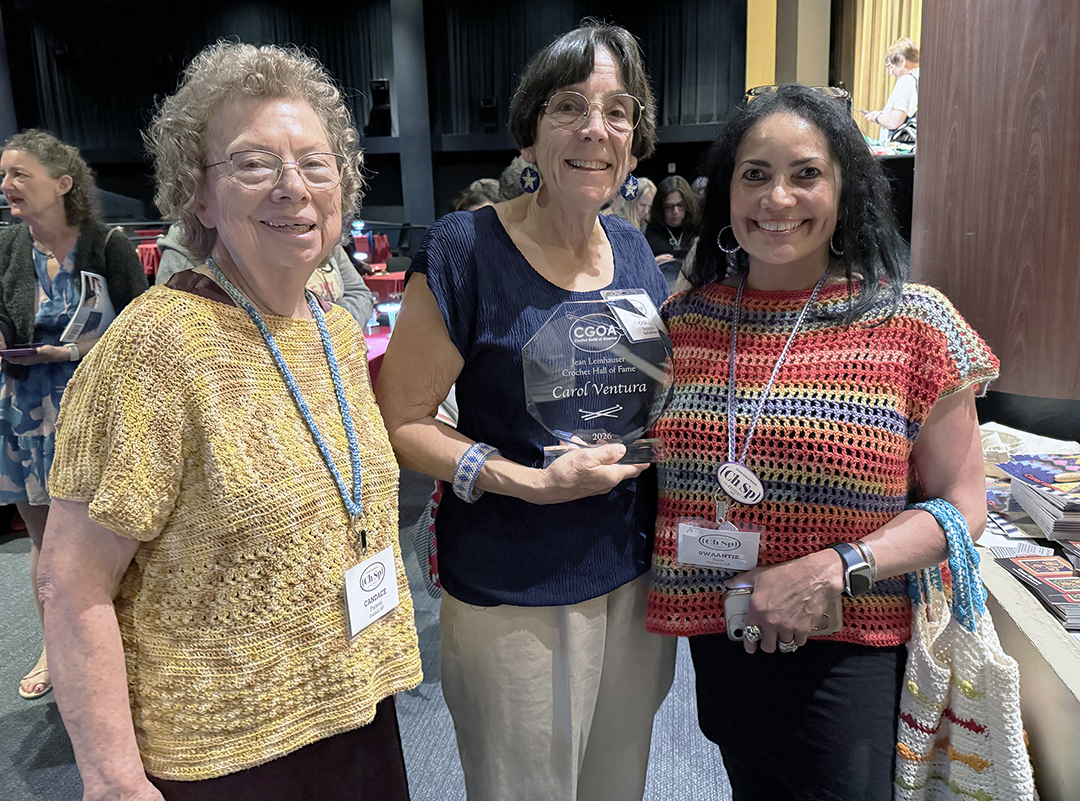
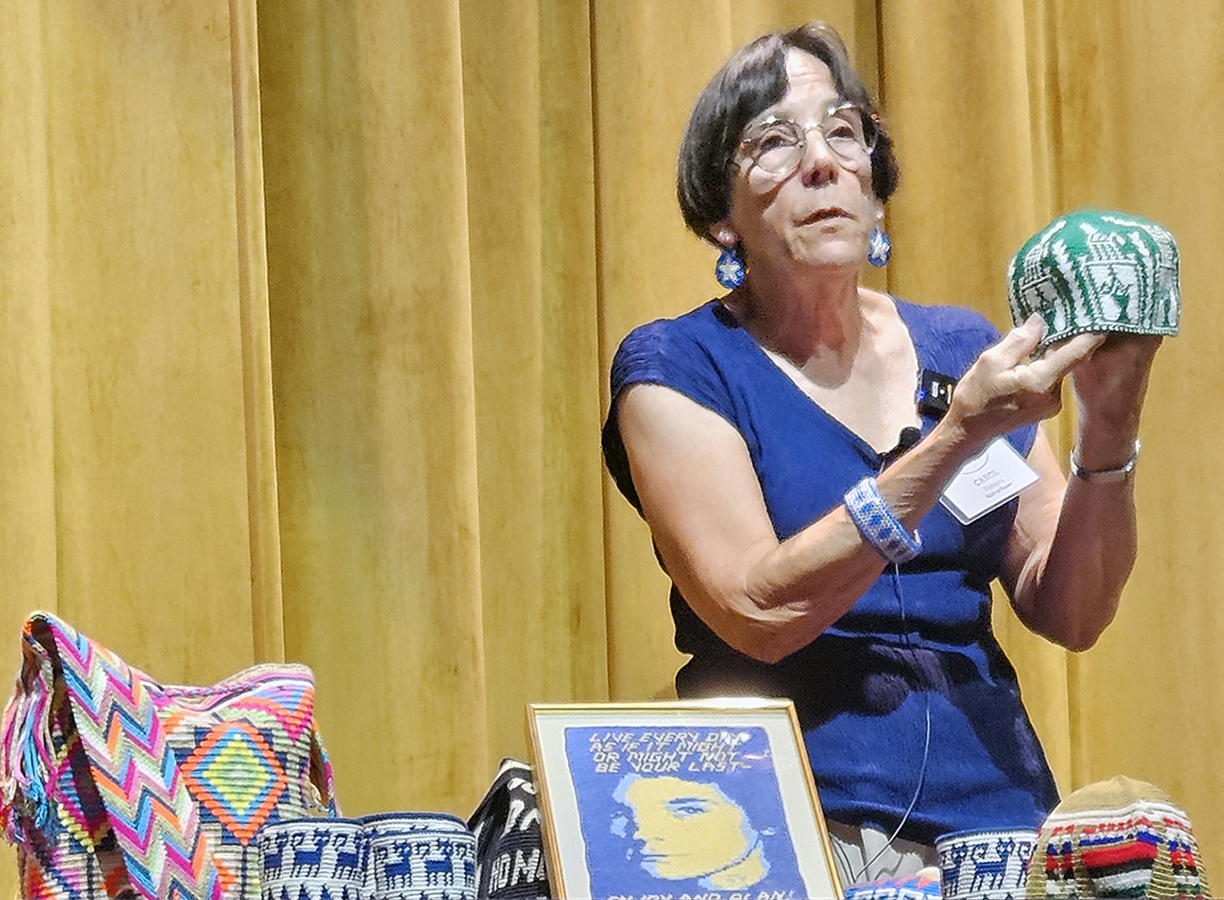
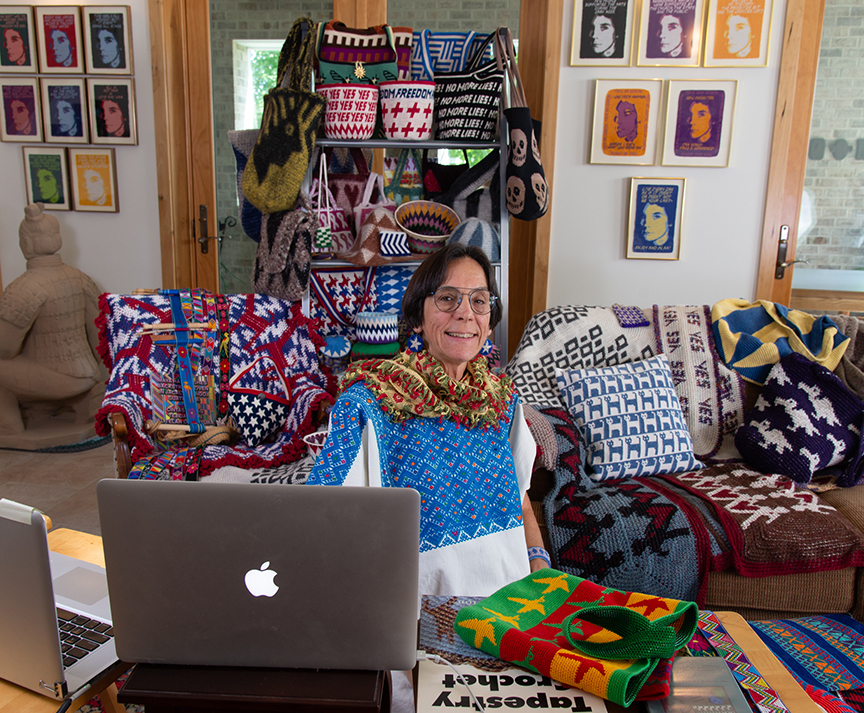
The July 2026 Crochet Guild of America Retreat took place at the Guest House at Graceland – actually a luxury hotel in Memphis. I played tourist during the day, then after dinner they inducted me into the Jean Leinhauser Crochet Hall of Fame. I thanked everyone and talked about my background and tapestry crochet, then a long book signing line formed. I’m usually the one asking for photos and autographs, but the tables were turned because they asked me! I’m so honored to have been chosen by such a talented group of crocheters.
CGOA posted my Hall of Fame talk on their YouTube channel at https://www.youtube.com/watch?v=s2DRnzzwWhk&t=7s It was wonderful to be surrounded by such a talented and warm group of crochet enthusiasts!
John C. Campbell Folk School in North Carolina is a dream destination for creatives! I’ll be teaching tapestry crochet there June 21st-27th – a whole week to learn, improve and really get into this enjoyable craft. Please spread the word, or better yet, sign up here. You may choose to make the below projects or I can help you design and tapestry crochet your own.
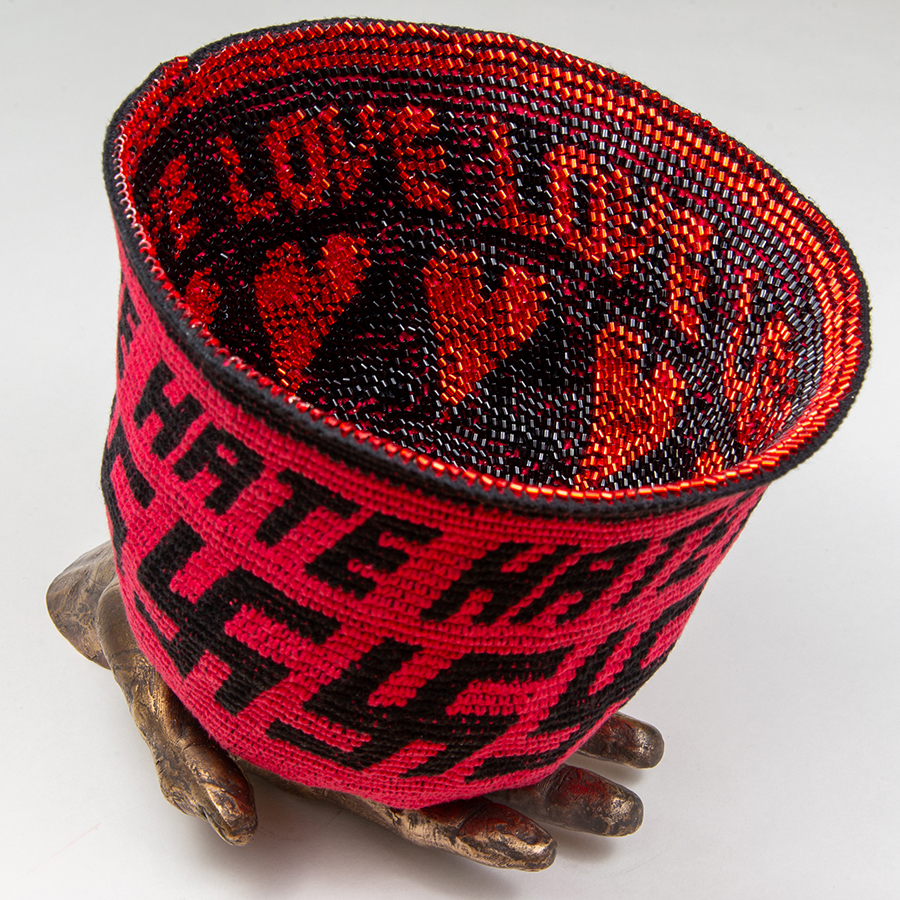
My bead tapestry crochet basket, Your Choice, is included in the National Basketry Organization’s Basketry Now 2025 exhibition through October 18, 2025 at the Textile Center in Minneapolis.
Carol Ventura, Your Choice, tapestry crochet with cotton and glass beads, 8.25” high x 8” wide x 9” long with bronze hand, 2024.
Your Choice was tapestry crocheted with four colored threads (each loaded with one bead color) in a spiral that moved from the center of the bottom outward and upwards towards the rim, like the spiral of life. Switching the threads back and forth while placing a bead behind each stitch created the contrasting imagery on the inside and outside. Black and red beads along the rim spell out CV2024 in binary. The basket is offered by my lost wax cast bronze hand.
The black words, swastikas, and beads symbolize evil. The brilliant red beads on the inside of the basket represent love, while the drab red thread on the outside symbolizes blood. We cannot control everything that life presents, but every choice we make has benefits and consequences. It is your choice to walk a path of love or hate.
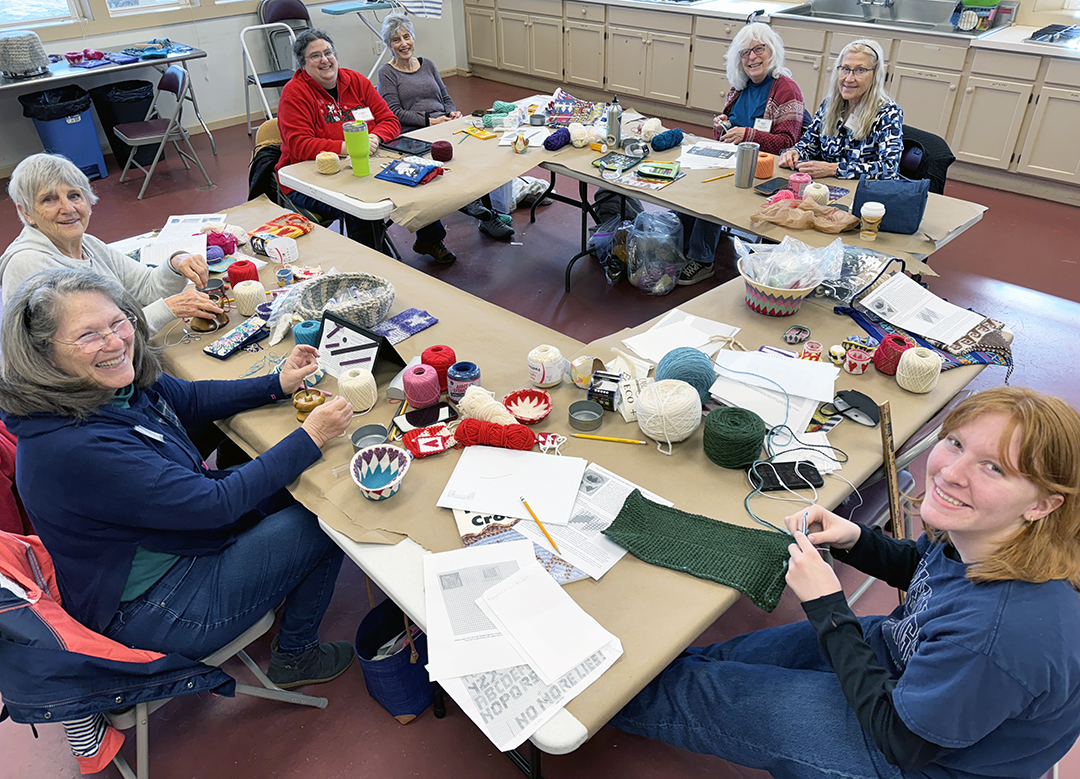
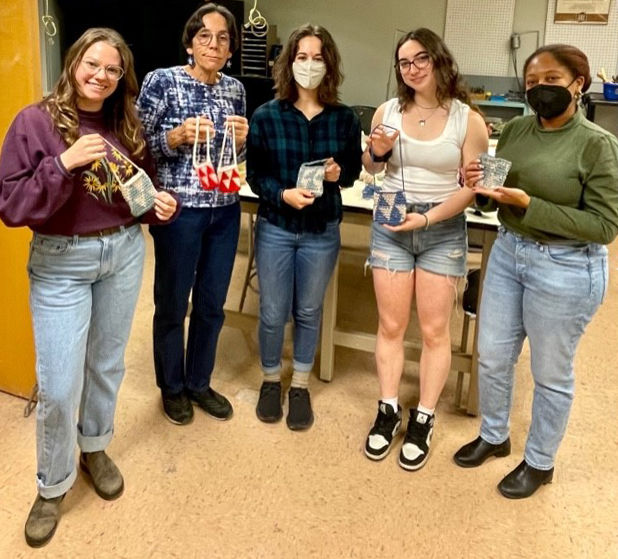
I’ve taught lots of half and full day tapestry crochet classes, but last week was the first time I was able to teach the same group for 5 days! It was great not to be rushed and everyone was able to finish a variety of beaded, felted, and flat tapestry crochet projects. Although we came from different states and backgrounds, we all bonded over tapestry crochet!
The Best of Tennessee Craft: 2024 Biennial opened at Arrowmont School of Arts & Crafts in Gatlinburg, TN, on October 14th. These bead tapestry crochet baskets are among the over 70 artworks from some of the best craft artists in Tennessee.
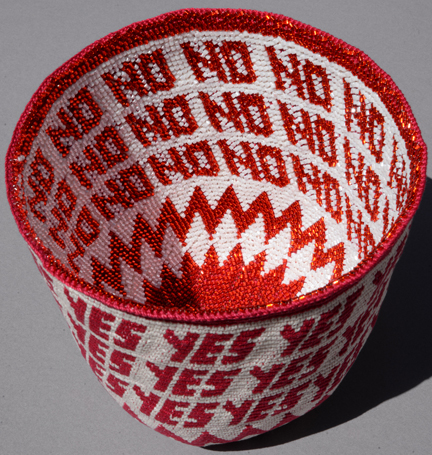
Yes No, 8 1/2″ x 7 1/2″, bead tapestry crochet, 2019.
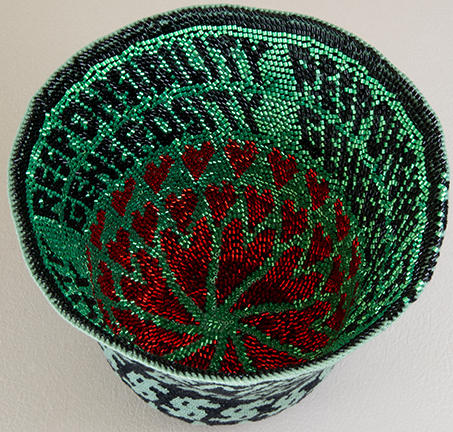
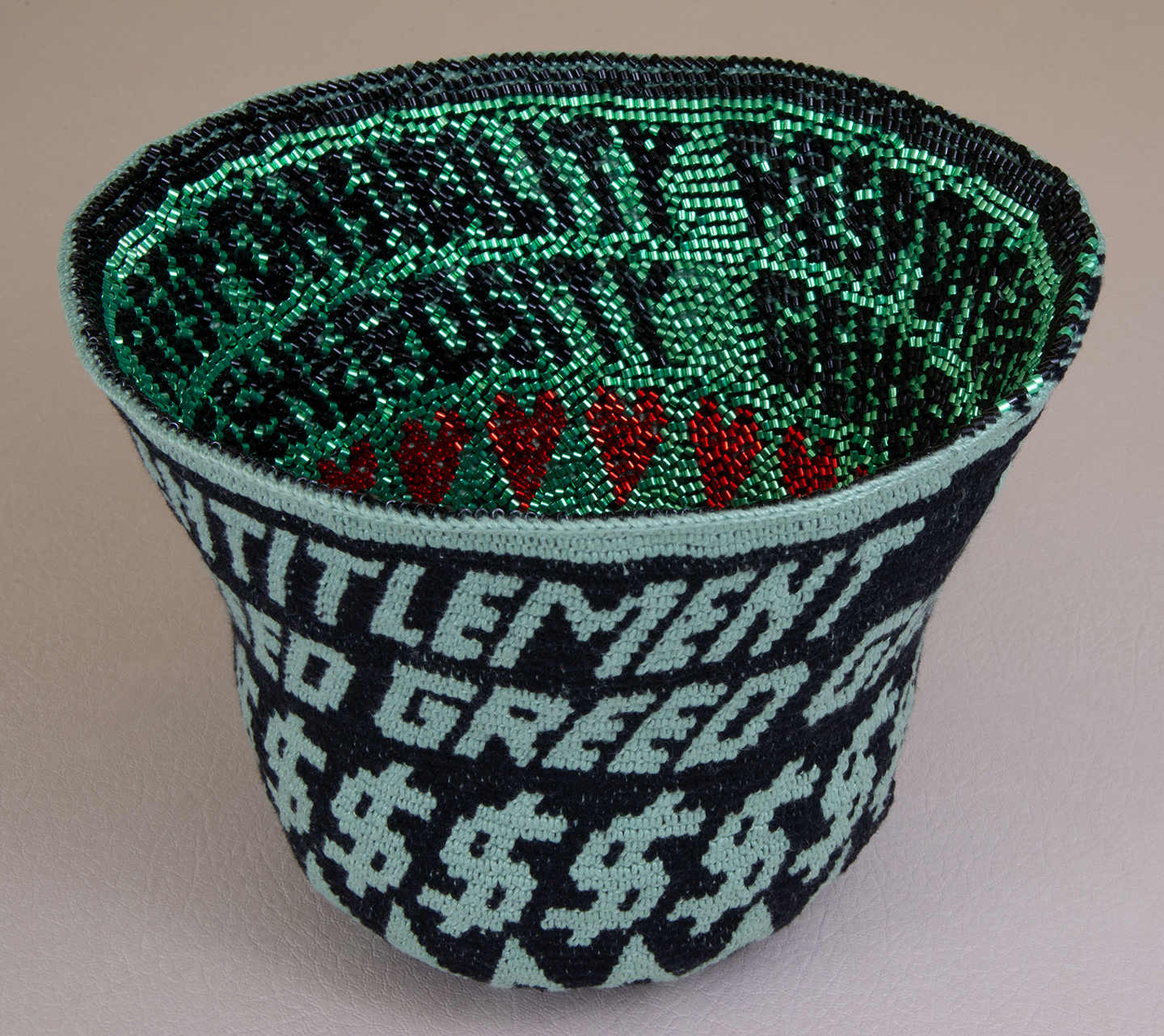
Positive Negative: Greed vs Generosity and Entitlement vs Responsibility, cotton thread and glass beads, 7″ x 9 1/2″, 2022.
Unfortunately, I won’t be able to make the closing Artist Reception on December 13th from 5-7pm, but I hope you will!
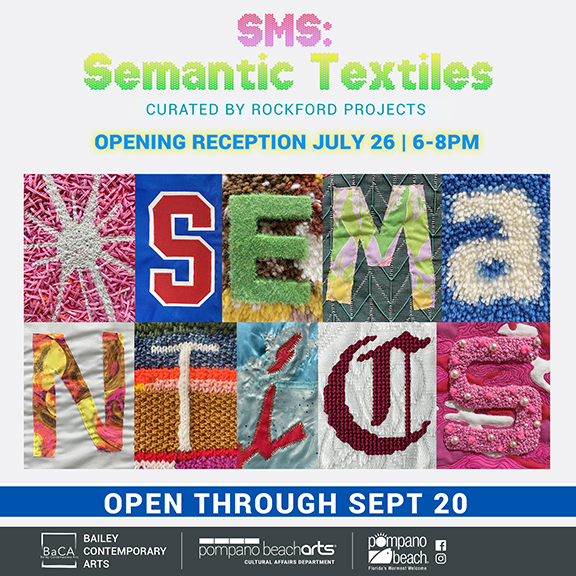
An exhibit that opens July 26th at Bailey Contemporary Arts in Pompano Beach, Florida, features textiles that incorporate words into the fabrics. I’m happy to say that my Yes No and White Lies bead tapestry crochet baskets and He Said / She Said, Too are included.
Yes No, 8 1/2″ x 7 1/2″, bead tapestry crochet, 2019.
Yes No is read from top to bottom:
Three rounds of Yes and three rounds of No. Twelve Yes and Twelve No on every row. Twenty-four up and down all around. Twenty-four diamonds in a row. Twelve merged hearts below. How many times is Yes a No?”
You may interpret the message as you wish, but my intention is that the victim is saying, “No”, but the perpetrator is saying,” Yes”.
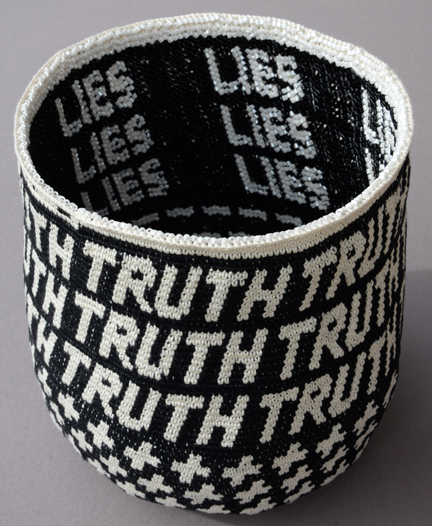
White Lies, 8.5” x 8”, bead tapestry crochet, 2019.
What inspired White Lies? We live in a complex world where very little is black and white. The truth hurts but is ultimately less painful than an embellished white lie. Let there be light. Let there be truth. Let there be no more white lies!
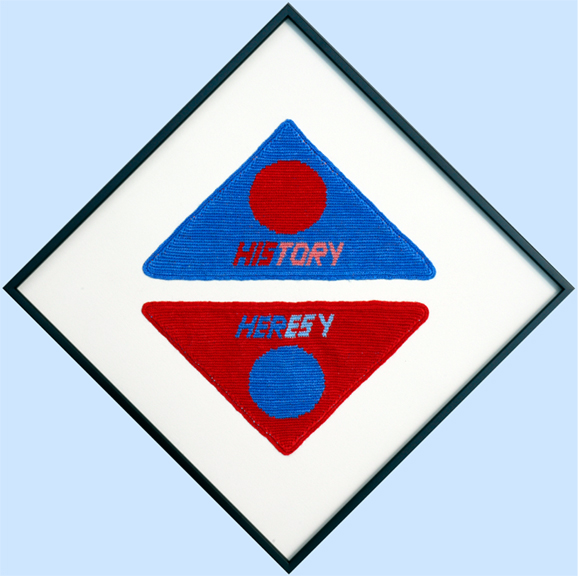
He Said / She Said, Too, 17 1/4″ x 17 1/4″ framed size, tapestry crochet, linen, 2000.
He Said She Said, Too, is based on my observation that history, for the most part, has been written by men from their point of view. What women say is often labeled as heretical. The same situation is often perceived very differently from a man’s or a woman’s point of view. This is the second of 2 pieces that explore the same topic.
Unfortunately, I won’t be able to see the exhibit in person – but I hope that you can! If so, please post comments and pictures!
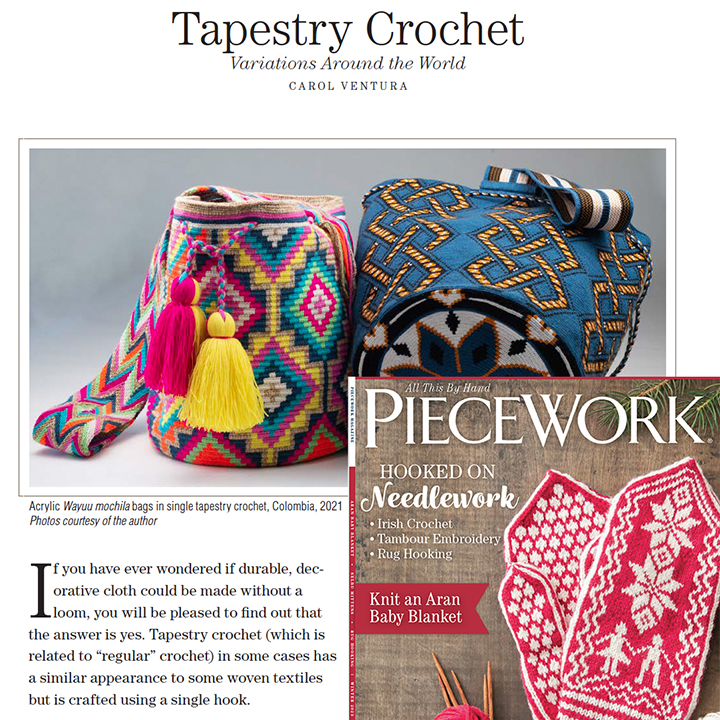
Needlework is the theme of the Winter 2023 issue of PieceWork Magazine. This issue includes several articles about crochet, including my own that looks at tapestry crochet stitch variations in Colombia, Guatemala, Finland, Israel, Türkiye, Cameroon, and Morocco.
I thought of titling it “Different Strokes for Different Folks” because there’s no right or wrong way to tapestry crochet. The choices are many: the type and number of yarns, loose or tight tension, slip or single or half or double crochet stitches, carry the color or run it along the back, insert the hook into one or more loops? These choices influence the imagery and determine whether the fabric will be stiff or supple. I hope you’ll be inspired.
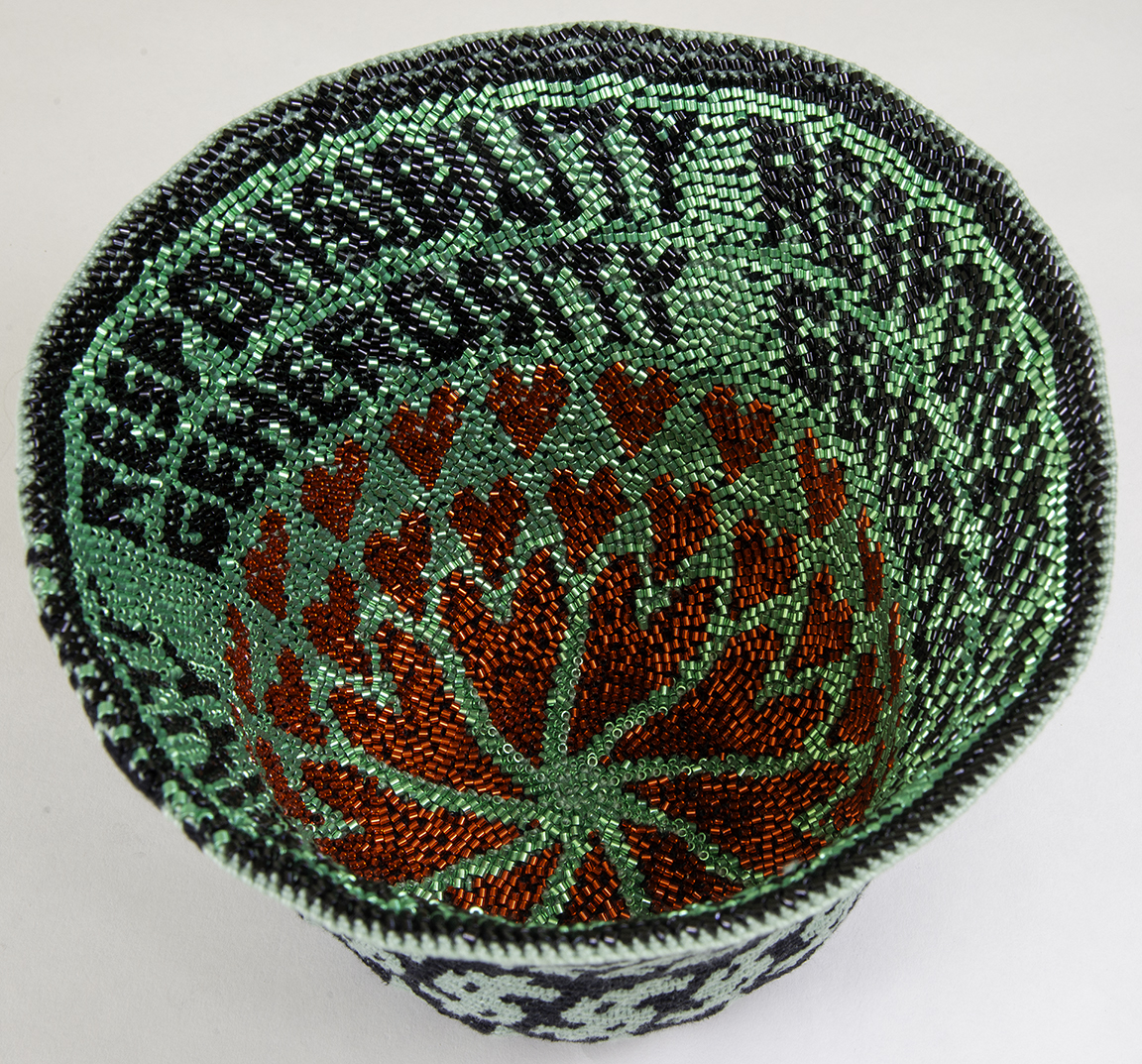
Positive Negative: Greed vs Generosity and Entitlement vs Responsibility is my most recent double sided bead tapestry crocheted piece. The open rim and positive dazzling interior invite and emanate love and the qualities that I hope will overpower the negativity of the exterior.
Positive Negative: Greed vs Generosity and Entitlement vs Responsibility, cotton thread and glass beads, 7″ x 9 1/2″, 2022.
I should probably rename it Negative Positive because this basket was rejected by one juror but awarded second place in another international exhibit, Small Expressions, sponsored by the Handweavers Guild of America. This traveling exhibit will be at Pacific Northwest Quilt & Fiber Arts Museum, WA, July 5 – September 3, 2023; Haywood Community College, NC, September 21 – November 9, 2023; Yadkin Valley Fiber Center, NC, December 8, 2023 – February 15, 2024; and Vanderbilt’s Sarratt Gallery, TN, March through early May, 2024. I hope you’ll be able to see it in person and soak up the positivity!
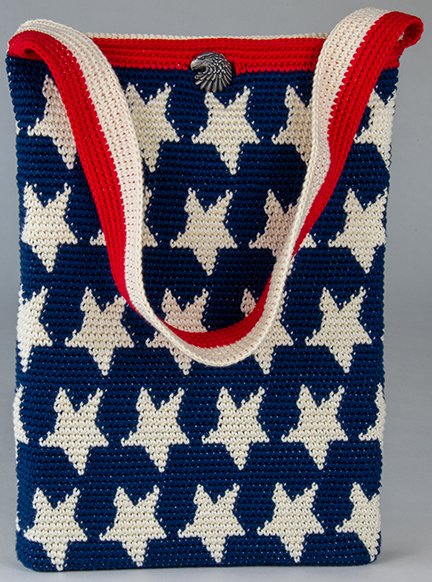
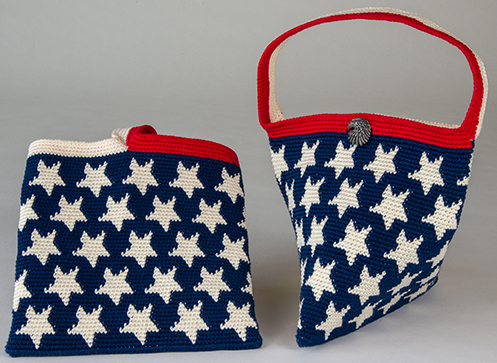
The American flag has inspired several projects over the years. A few magazine and book publishers let designers keep their rights, but most don’t. Since I no longer own the rights to my previous “flag bags” I decided to design some more. The below example has a narrow oval base, a 13 stitch wide star motif (to commemorate our original colonies), and 50 stars. The 1″ wide eagle button is perfect, don’t you think?
Stars Shoulder Bag, tapestry crocheted with Omega Sinfonia cotton, 13 1/4 x 9 1/2″, 2023.
My original intention was to make a more three-dimensional shaped purse (like the one below) but the above bag is too tall and the fabric is not very stiff, so I redesigned and repositioned the stars and switched to a smaller hook. The size 1 hook and tight tension produced a stiffer fabric that maintains the triangular shape (formed by the button and handle placements).
All the bags in this posting were crocheted with my new favorite, Omega Sinfonia cotton, which is thicker than size 3 cotton thread and available in more colors.
So, what do you think? The Stars Shoulder Bag and Patriotic Purse patterns are available on Ravelry, and you don’t need to be a member to purchase them. I hope you’ll give them a try!
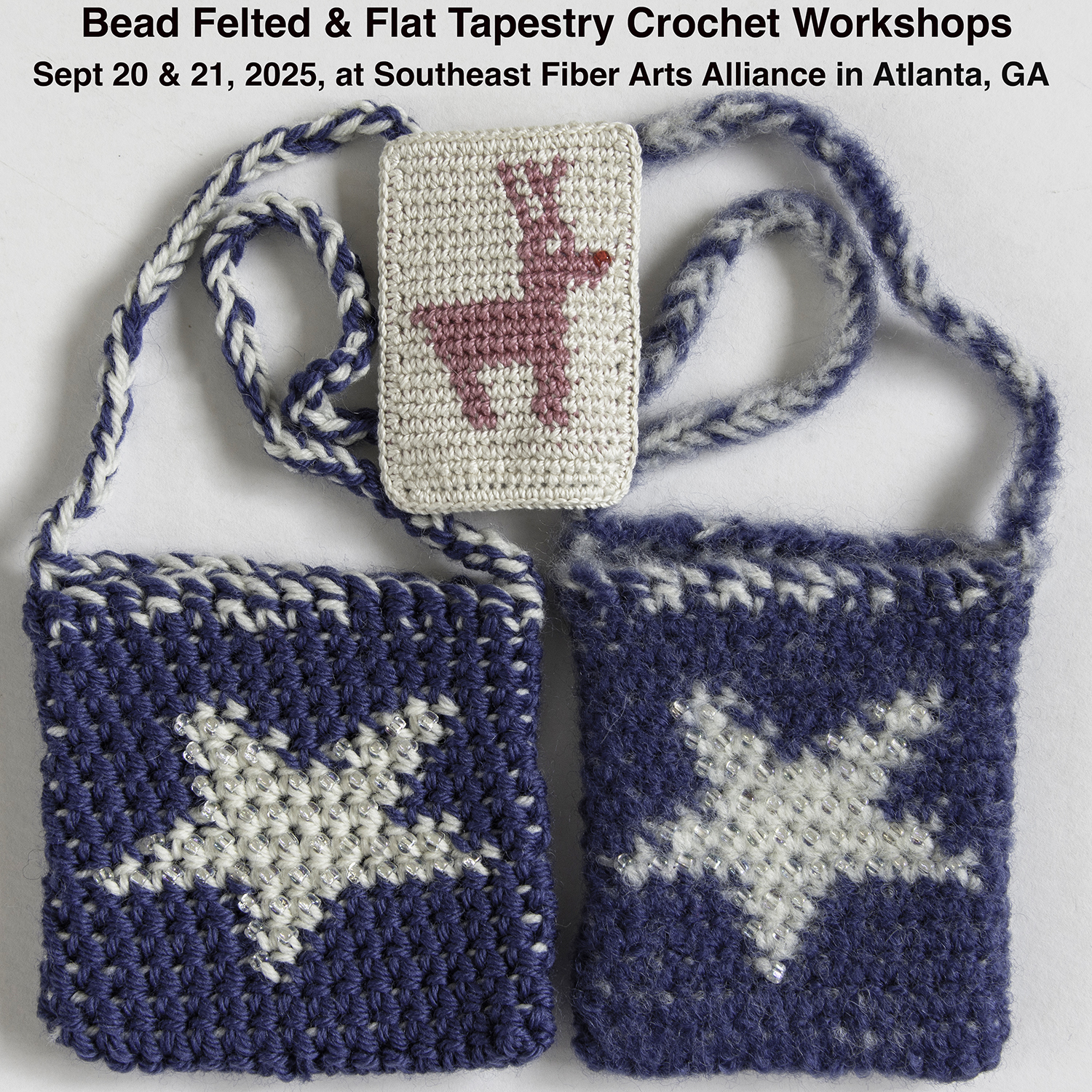
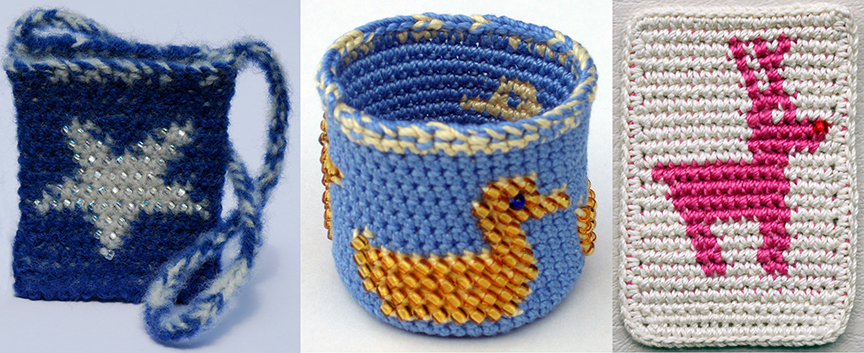
My three day tapestry crochet workshop (August 26-28, 2023) at Touchstone Center for Crafts in Farmington, PA, is already open for registration! We’ll do the above projects, one each day. I’ll also teach how to design motifs with three different tapestry crochet graph papers, use a bead spinner to thread beads onto yarn, and block projects with a steam iron.
A large hook, two wool yarns (one beaded), and loose single crochet stitches will be used to tapestry crochet the flat bead felted bag on Saturday.
A cylindrical beaded basket will be tapestry crocheted with a smaller hook, beaded cotton threads, and tighter stitches on Sunday. Each thread will be loaded with one bead color, eliminating the need to load the beads in a specific color sequence ahead of time! The motif is formed on one side of the fabric by adding a bead to each stitch and on the other side the colored threads echo the image.
Flat tapestry crochet will be the focus on Monday. Unlike traditional crochet, flat tapestry crochet does not show the back of the stitches on every other row.
It will be lots of fun and learning, too! I hope to see you there!
Tapestry crochet redirects my mind to focus on things within my control – and since repetitive activities (like crocheting) release endorphins, I owe it my sanity. Designing new pieces stimulates my creative side and incorporating words adds another dimension. Sharing each finished project is pure joy, especially when someone notices.
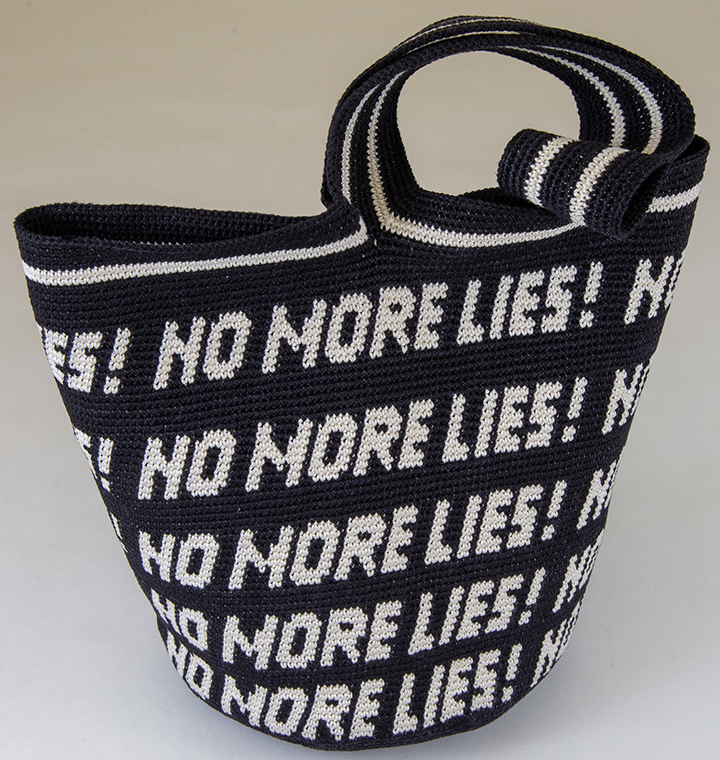
White Lies Toteby Carol Ventura, tapestry crochet cotton, 8″ x 10″, 2022.
I was raised to trust people, to believe what they say. Although experience has made me less naive, I’m still a walking target. I detest all lies, even the little white ones because misinformation is destroying lives and the planet. My latest pattern expresses my personal frustration but the instructions include the alphabet, for more upbeat or even darker messages. It’s cathartic!
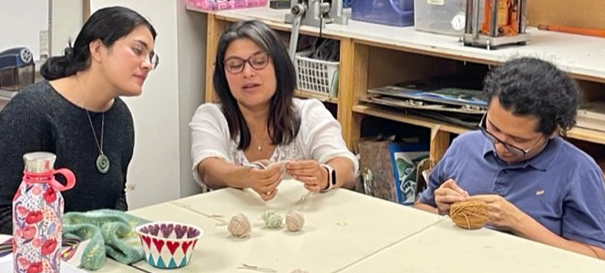
The weather turned cold and wet in Tennessee a few days ago, making it the perfect time to stay inside and learn something new at the Sarratt Art Studios of Vanderbilt University in Nashville. I learned about tapestry crochet in Guatemala. A few of the participants in my Felted Tapestry Crochet Bag workshop were Guatemalan so tapestry crochet came full circle over the weekend! In fact, the gentleman on the right (below) is from Jacaltenango, the remote town where I was a Peace Corps volunteer in the 1970’s. Small world!
Beginning the bag on the bottom . . .
The wool bags will be felted in a washing machine.
Hopefully, everyone who participated will help spread the news about this wonderful technique by teaching tapestry crochet to others who will teach it to others who will teach it to others . . .